

Receiving USD in Nigeria should be straightforward.
A client sends you money.
Your bank receives it.
You spend it.
Unfortunately, that’s rarely how it works.
If you’re a freelancer, remote worker, business owner or agency receiving international payments, you’ve probably noticed that the amount you finally receive is often lower than what your client actually sent. Then, when it’s time to convert those dollars into naira, your balance shrinks even further.
At first, it feels like the cost of doing business.
However, after tracking my international payments for almost a year, I realised something surprising.
The biggest problem wasn’t receiving dollars.
It was how I managed them afterwards.
Once I understood where the money was leaking, I completely changed my payment workflow. As a result, I reduced unnecessary costs and made my international payments much easier to manage.
Here’s what I learned.
Why Receiving USD in Nigeria Costs More Than Most People Realise
When someone sends you USD from abroad, the money doesn’t move directly from their account into yours.
Instead, it passes through several institutions before reaching Nigeria.
A typical payment looks like this:
Client → Sending Bank → Correspondent Bank → Nigerian Bank → Currency Conversion → You
At almost every stage, there’s an opportunity for fees or exchange rate losses.
Some are visible.
Others are hidden.
Unfortunately, the hidden ones usually cost the most.
Where Your Money Actually Goes
Let’s use a $5,000 international payment as an example.
Although every transaction is different, this is what many Nigerians typically experience when receiving USD through a domiciliary account.
| Stage | Typical Cost | Remaining Balance |
|---|---|---|
| Client sends payment | — | $5,000 |
| Sending bank wire fee* | $20–$40 | $4,960–$4,980 |
| Correspondent bank deduction | $15–$30 | $4,930–$4,965 |
| Receiving bank processing | $10–$20 | $4,910–$4,955 |
| FX conversion spread (3–6%) | $150–$280 equivalent | $4,650–$4,760 |
*Some clients absorb the wire fee, while others deduct it before sending.
Looking at the table, the transfer fees seem manageable.
However, the largest cost usually isn’t the wire fee.
It’s the exchange rate.
Read Also: Hidden Fees on Nigerian Bank Cards You Should Know
The Biggest Hidden Bank Charge Nobody Talks About
Most people complain about transfer charges.
Ironically, those aren’t usually where the biggest losses occur.
The real cost comes from foreign exchange (FX) spreads.
Unlike transfer fees, banks don’t normally show an “FX charge” on your statement.
Instead, they simply offer a conversion rate that’s lower than the prevailing market rate.
For example, imagine the market rate is significantly higher than the rate your bank offers.
You won’t see a separate deduction.
You’ll simply receive fewer naira for every dollar.
Because the difference is hidden inside the exchange rate, many people never realise how much they’re losing.
Over dozens of international payments, those small differences quickly become one of the biggest expenses in your business.
The Mistake Most Nigerians Make
For months, I followed the same routine.
A client paid me in USD.
The money landed in my domiciliary account.
I immediately converted everything into naira.
A few days later, I paid for:
- ChatGPT Plus
- Canva Pro
- Adobe Creative Cloud
- Meta Ads
- Google Ads
- Google Workspace
- AWS
- Spotify
The problem?
Every one of those companies charges in USD.
So my payment journey looked like this:
USD → NGN → USD
I converted my dollars into naira.
Then my Nigerian debit card converted that naira back into dollars.
Without realising it, I was paying for foreign exchange twice.
The bank wasn’t necessarily overcharging me.
My workflow simply wasn’t efficient.
What Changed
Instead of changing banks, I changed how I handled my money.
First, I stopped converting every payment immediately.
Instead, I only converted the amount I needed for local expenses like salaries, rent and operating costs.
Everything else stayed in USD.
Next, I separated my Nigerian expenses from my international expenses.
That single decision made a noticeable difference.
A Smarter Way to Receive USD in Nigeria
Today, my payment flow looks much simpler.
| Traditional Method | Smarter Method |
|---|---|
| Client pays in USD | Client pays in USD |
| Funds arrive in domiciliary account | Funds arrive in domiciliary account |
| Convert everything to NGN | Keep funds in USD |
| Use Nigerian debit card | Fund Yolat Virtual Dollar Card |
| Bank converts NGN back to USD | Pay merchants directly in USD |
| Multiple FX charges | Minimal FX exposure |
By removing unnecessary currency conversions, I reduced avoidable FX losses while making international payments far more predictable.
Why I Started Using Yolat
A domiciliary account is still useful.
I still use mine for receiving international wire transfers.
However, I no longer rely on it for everything.
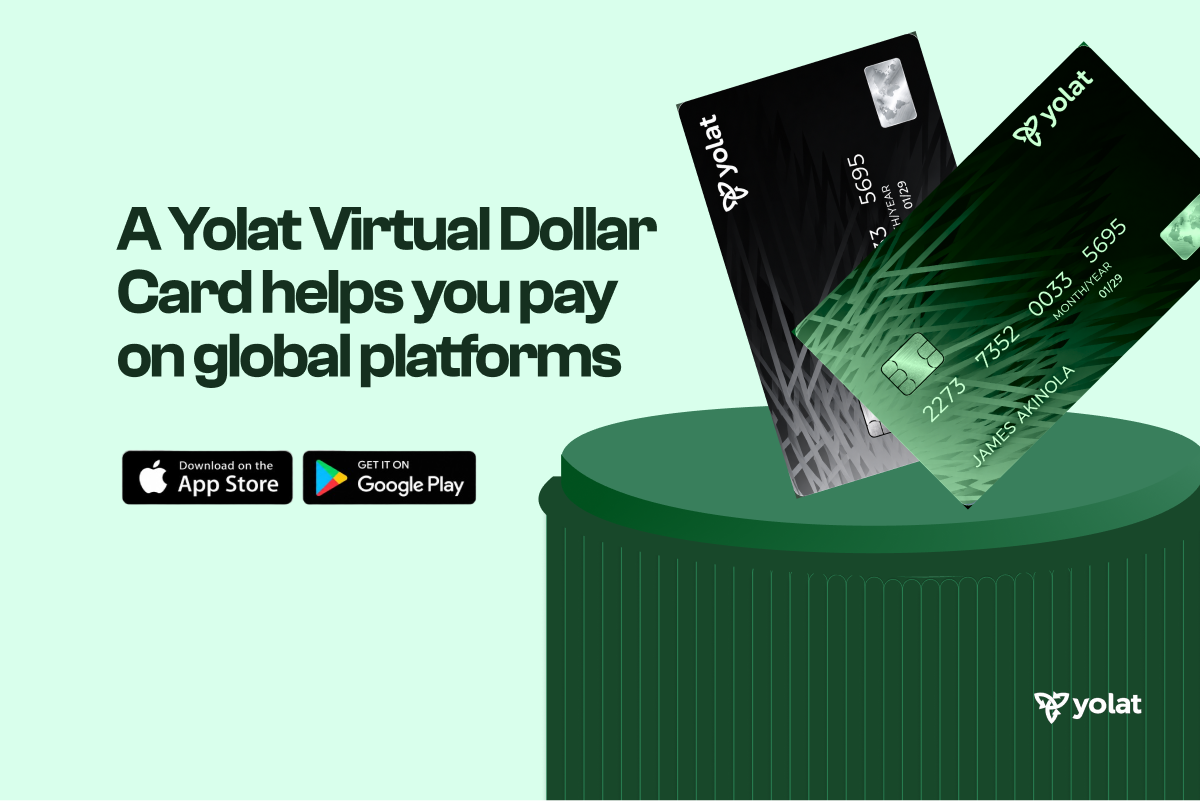
Instead, I use Yolat’s Virtual Dollar Card whenever I need to pay international merchants.
That means I can pay directly for:
- ChatGPT
- Canva
- Adobe
- Meta Ads
- Google Ads
- Netflix
- AWS
- Spotify
- International online stores
without converting my dollars into naira first.
More importantly, I only convert USD when I actually need naira.
As a result, I avoid unnecessary exchange losses every single month.
Traditional Workflow vs Smarter Workflow
| Traditional Method | Smarter Method |
|---|---|
| Convert every USD payment immediately | Hold USD until conversion is necessary |
| Pay international merchants with a Nigerian card | Pay directly with a Virtual Dollar Card |
| Multiple FX conversions | Fewer currency conversions |
| Higher exposure to FX spreads | Better control over USD spending |
| Mixed local and international expenses | Separate payment workflows |
Although both methods work, the second approach usually results in fewer unnecessary costs over time.
When You Still Need a Domiciliary Account
Despite everything, a domiciliary account still has an important role.
It’s ideal for:
- Receiving SWIFT payments
- International client transfers
- Holding USD savings
- Business documentation
- Corporate transactions
The goal isn’t to replace your domiciliary account.
Instead, it’s to stop asking it to solve every payment problem.
Frequently Asked Questions
Is receiving USD in Nigeria expensive?
It can be. Besides transfer fees, many people lose money through correspondent bank deductions, receiving charges and repeated foreign exchange conversions.
Should I convert every USD payment immediately?
Not necessarily.
If you’ll later spend money internationally, holding part of your balance in USD may reduce unnecessary FX costs.
What causes hidden bank charges?
The most common causes include correspondent bank fees, receiving bank charges and exchange rate spreads.
Can I pay international merchants without using my Nigerian debit card?
Yes.
A Virtual Dollar Card allows you to pay international merchants directly in USD, reducing repeated currency conversions.
Final Thoughts
Receiving international payments shouldn’t mean losing a portion of your earnings before you can use them.
Unfortunately, many Nigerians unknowingly lose money through bank charges, correspondent fees and repeated foreign exchange conversions.
Fortunately, reducing those costs doesn’t always require changing banks.
Sometimes, it simply requires changing your workflow.
By keeping part of your earnings in USD, converting only what you need and using Yolat’s Virtual Dollar Card for international payments, you can eliminate unnecessary conversions, simplify your payment process and keep more of the dollars you’ve already earned.
After all, earning more money is important.
Keeping more of it is even better.
Leave a Reply